The 1911 Triangle Shirtwaist Fire Reminds Us That Labor is a Cultural Fight
“[W]e were, due to our ignorance and poverty, helpless against the power of the exploiters,” described Triangle Shirtwaist worker Pauline M. Newman in a letter speaking about her experience at the factory.[1] The 1911 Triangle Shirtwaist Fire killed 146 workers in New York City but covertly revealed the American cultural violence which maintained tacit silence on worker concerns until bodies started dropping in the public street. Structural violence in the form of unsafe working conditions became normalized under a cultural veil of public/private partitions that relegated concerns to outside the public’s view. After the fire, American legal theory shattered when the unsafe work conditions that caused Triangle’s demise could no longer be ignored in public discourse.
Before the fire at Triangle, workers were combative but unsuccessful in their protests against the working conditions that they suffered. Newman described laborers working past their shift end without overtime, low wages with long days, and a management team that enacted conditions that “were the acme of exploitation perpetrated by humans upon defenceless (sic) men women and children — a sort of punishment for being poor and docile”; still, she reflected on this past by writing that “workers of those days were evidently willing to accept such conditions of labor without protest.”[2] Unsafe working conditions and the accidents that came from them were simultaneously accepted “as either the fault of the workers themselves or as ‘a mysterious dispensation of Providence.’”[3] Newman’s description of labor’s acceptance may read peculiar to a modern audience, but it had been normalized by the American culture that surrounded it.
Newman perfectly summarizes why a strike couldn’t be — and wasn’t — successful when she asserts that there was no good to change jobs “since similar conditions existed in all garment factories of that era” and that laborers clung to each other for a “feeling of belonging which helps to make life in a factory a bit easier to endure.” Put simply, the culture which prevented the public from sympathizing with laborers had created an environment where change became unfeasible in all jobs since management knew they would not be held accountable for the conditions of their factories or the employees that worked in them. Legal Historian Arthur McEvoy described how this divide manifested in legal theories of causality which “since the beginning of the Industrial Revolution made workplace injuries a private matter” that “threw a dense cloak over accidents that took place inside the workplace.”[4] Any cause of action or blame on capital was made impossible by this cloak that withheld “scrutiny from their causes and its aid from their victims” in a form that “ratifies the employer’s authority to control” who was to blame for any workplace accident.[5]
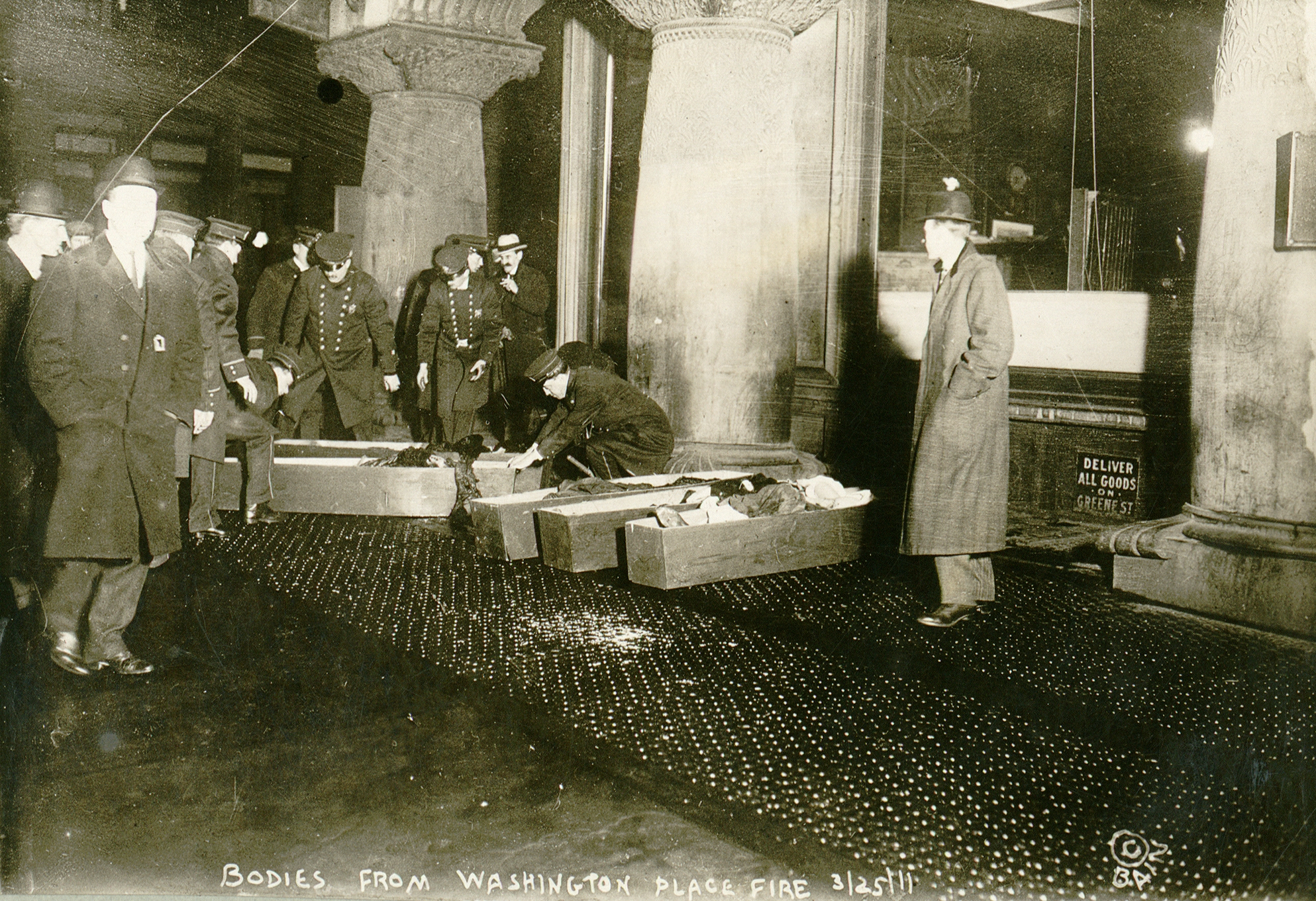
When Triangle caught fire, that dense private veil was pierced in a way that shocked bystanders as they witnessed laborers jump several stories to their demise to try escaping from the fire. In a photo captured at the scene, bystanders stood aghast at the burning factory while bodies had literally piled beside them.[6] Newspaper articles described “[t]housands of people who had crushed in from Broadway and Washington Square and were screaming with horror at what they saw” as “141 young men and women[,] at least 125 of them mere girls were burned to death or killed by jumping to the pavement below.”[7] Editorial cartoons described the victims as having been “murdered” without any culprit punished.[8] No longer could Americans ignore the conditions at Triangle and so the public (and, subsequently, the law) began hounding to find someone responsible for the deaths after this cultural rug had been pulled out from under capital’s foundation.
McEvoy described the response after the fire as “immediate and overwhelming” as it began to assign culpability to factory owners in a way that transformed “the ways in which the legal culture attributed causes to industrial accidents.”[9] Triangle was different because the haunting public effect provided no shield of secrecy that could allow factory owners Issac Harris and Max Blanck to hide behind. Harris and Blanck were charged with manslaughter by the District Attorney for violating labor laws that contributed to the inability of workers to escape from the fire.[10] Though their punishment was light at best, the indictments marked a crucial break from the cultural upholding that had justified past incidents in American labor history. Still, culture won out as Harris and Blanck escaped their trials since conservative causality remained according to McEvoy who best summarizes the point with one juror’s statement that concluded how the Triangle fires “must have been an act of God” for which the factory owners could not have been responsible for.[11]
To a 21st century audience, Triangle and the public that judged its causes seem cartoonishly primitive when it assigned blame everywhere except capital. Yet, this case best serves to demonstrate how labor’s fight extends beyond the superficial understanding that debates on worker rights are private concerns between workers and companies; instead, it requires a public cultural aspect that, if ignored, leads to the same pitfalls faced in the early 20th century in Triangle. When labor movements are disregarded as “none of our business,” irrelevant to the everyday American, or simply regarded as petty illegitimate grievances of selfish laborers and their self-inflicted harms, the exact same traps are laid as were done with Triangle for a monstrous system of structural violence guarded by the knight of cultural violence.
Image Credits: Library of Congress, cph.3a35469.
[1] Pauline M. Newman, “Letter to Michael and Hugh,” The 1911 Triangle Factory Fire Archive. https://trianglefire.ilr.cornell.edu/primary/letters/PaulineNewman.html.
[2] Newman.
[3] Arthur F. McEvoy, “The Triangle Shirtwaist Factory Fire of 1911: Social Change, Industrial Accidents, and the Evolution of Common-Sense Causality,” Law & Social Inquiry 20, no. 2 (Spring 1995), 630.
[4] McEvoy, 629.
[5] McEvoy, 631.
[6] Brown Brothers, Unnamed Photograph, March 25, 1911. https://trianglefire.ilr.cornell.edu/slides/151.html.
[7] “141 Men and Girls Die in Waist Factory Fire; Trapped High Up in Washington Place Building; Street Strewn with Bodies; Piles of Dead Inside,” New York Times, March 26, 1911.
[8] “This Is One of a Hundred Murdered: Is any one to be punished for this?,” https://trianglefire.ilr.cornell.edu/slides/246.html.
[9] McEvoy, 631; McEvoy, 626.
[10] “Indictments in the Asch Fire Case,” The Outlook, April 22, 1911.
[11] McEvoy, 637.